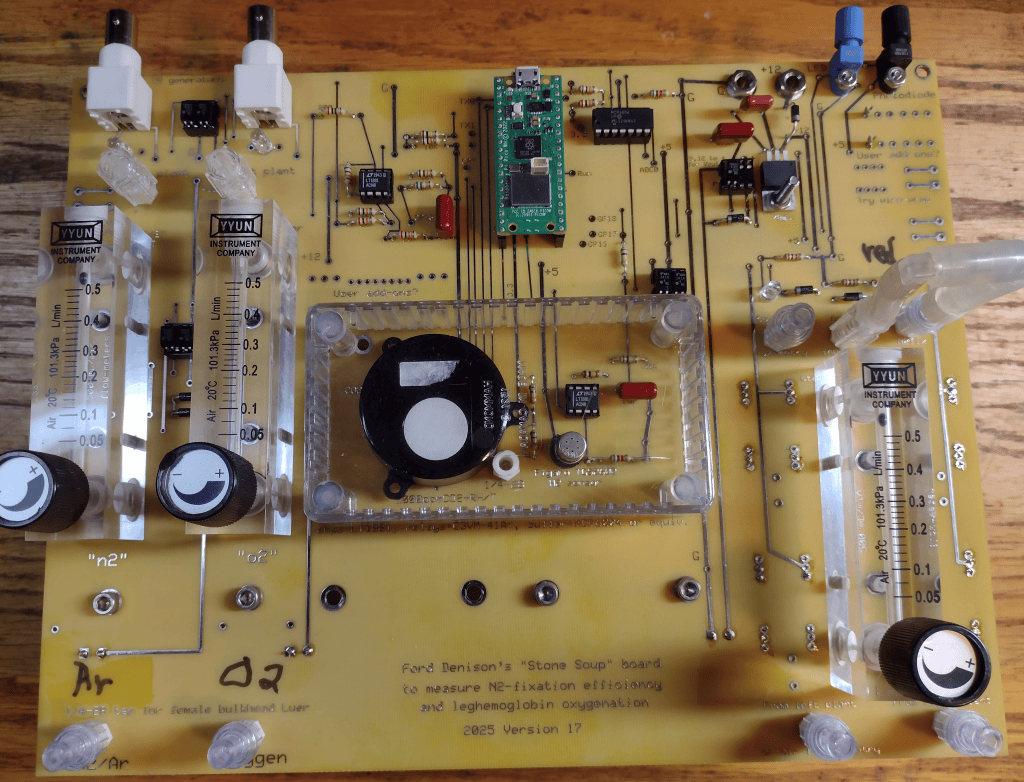
We’re getting close to submitting a paper on research we did in 2025 using this board, which I think was the first to use the Raspberry Pico (green rectangle) rather than the Arduino or PyBoard, I’ve made a series of improvements since then, however, reducing cost or complexity while mostly increasing capability.
With this version, users had to keep an eye on flowmeters to make sure flows weren’t changing. In the latest version, you have two options. The basic model doesn’t have flowmeters, since variation in flowrate is probably a small source of variation, relative to biological variation among plants. But a technology breakthrough lets me include two mass-flowmeters in the deluxe version.
The black disk is the CO2 meter we were using then. The SCD30 is probably less accurate, but cheaper, more consistently available, and easier to replace, since CO2 meter shown had to be soldered to the board. Our efficiency assay doesn’t require absolute accuracy in CO2, only in the change in CO2 with a change in oxygen. But I haven’t tested the efficiency assay with the SCD30 yet and won’t offer the PI for sale until I do. I have kept the option for users to solder on the CO2 meter, though, if they prefer.


Leave a Reply