History and Mission
The mission of Pretty Good Philosophical Instruments is to make methods I’ve developed over 40+ years accessible at prices any well-funded research lab (and maybe even some high schools or amateur scientists) can afford. The PI is optimized for measurements related to nitrogen fixation, the main focus of my research over 50 years. But it’s built around a Raspberry Pico, which runs Python and can support a wide range of sensors. I plan to explore a wide range of research projects in the blog, some of which might be great science fair projects.
My research career started with an undergraduate student project at The Evergreen State College, where I wrote a successful grant proposal for the much-lamented US National Science Foundation Student-Originated Studies program. The grant supported six of us for the summer to explore effects of acid rain on nitrogen-fixation in forests, using the acetylene-reduction assay to measure nitrogen fixation in lichens, alder roots, and soils. As a graduate student with Tom Sinclair at Cornell, I kept using acetylene reduction to study nitrogen fixation in soybeans. After postdocs on crop modeling and ecophysiology of Agave, with Bob Loomis and Park Nobel, respectively, I was hired by USDA-ARS as a Plant Physiologist, for research on forage crops, which included more work on nitrogen fixation.
USDA supported a 6-month collaboration with Dave Layzell, in Ontario, who pioneered using red light transmission of soybean nodules to measure the oxygenation of the plant hemoglobin inside. By manipulating external oxygen, we could measure nodule-interior respiration and nodule permeability to oxygen, which turned out to be key to plant responses to everything from loss of photosynthetic leaves to increases in soil nitrogen. I figured out how to replace a wheelbarrow full of equipment (lock-in amplifier, chart-recorder, etc.) with a little microcomputer, a new technology at the time. Our patent of the “nodule oximeter” is long expired and I haven’t seen publications using this method in decades, but I’ve added fiber-optic connectors to the PI to support these assays (also requires compressed gases).
About a year later, USDA sent me and my portable nodule oximeter to Wales, for a one-month collaboration with John Witty and Frank Minchin. They were measuring production of hydrogen, a byproduct of nitrogen fixation, and even invented an electrode that could measure hydrogen concentration inside nodules. So we could compare hydrogen permeability with oxygen permeability, showing that they changed together under stress.
After 6 years with USDA, I spent 12 years teaching and doing research as a professor in the Agronomy Department at the University of California, Davis. There, I directed the first 10 years of a “100-year experiment” that survived another 20 years after I stepped down. My research on nitrogen fixation took an interesting turn, as I realized that rhizobia and their legume hosts could have conflicting interests. Working with Bob Rousseau, Toby Kiers, and Stuart West, we used nodule oximetry to show that soybeans decrease oxygen permeability to shut down root nodules that stop fixing nitrogen.
Retiring early from UC Davis to join my wife at the University of Minnesota, I took a position as an Adjunct Professor in Ecology, Evolution, and Behavior. At some point, I’d started using hydrogen production by nodules as a proxy for nitrogen fixation. This let Ryoko Oono and Katherine Muller measure the respiration cost of N fixation to plants. They showed that some legume species manipulate rhizobia to make them fix nitrogen more efficiently (more NH3 per CO2) and that rhizobia that hoarding a lipid, PHB, reduces the nitrogen benefit rhizobia provide, relative to their carbon cost to the plant.
Nearing retirement, though, I noticed that other scientists were reading and citing our papers, but rarely adopting our methods. I realized that the equipment we’ve used for nodule oximetry and to measure NH3-per-CO2 efficiency cost thousands of dollars, which could keep other researchers from duplicating our experiments or using our methods for new experiments.
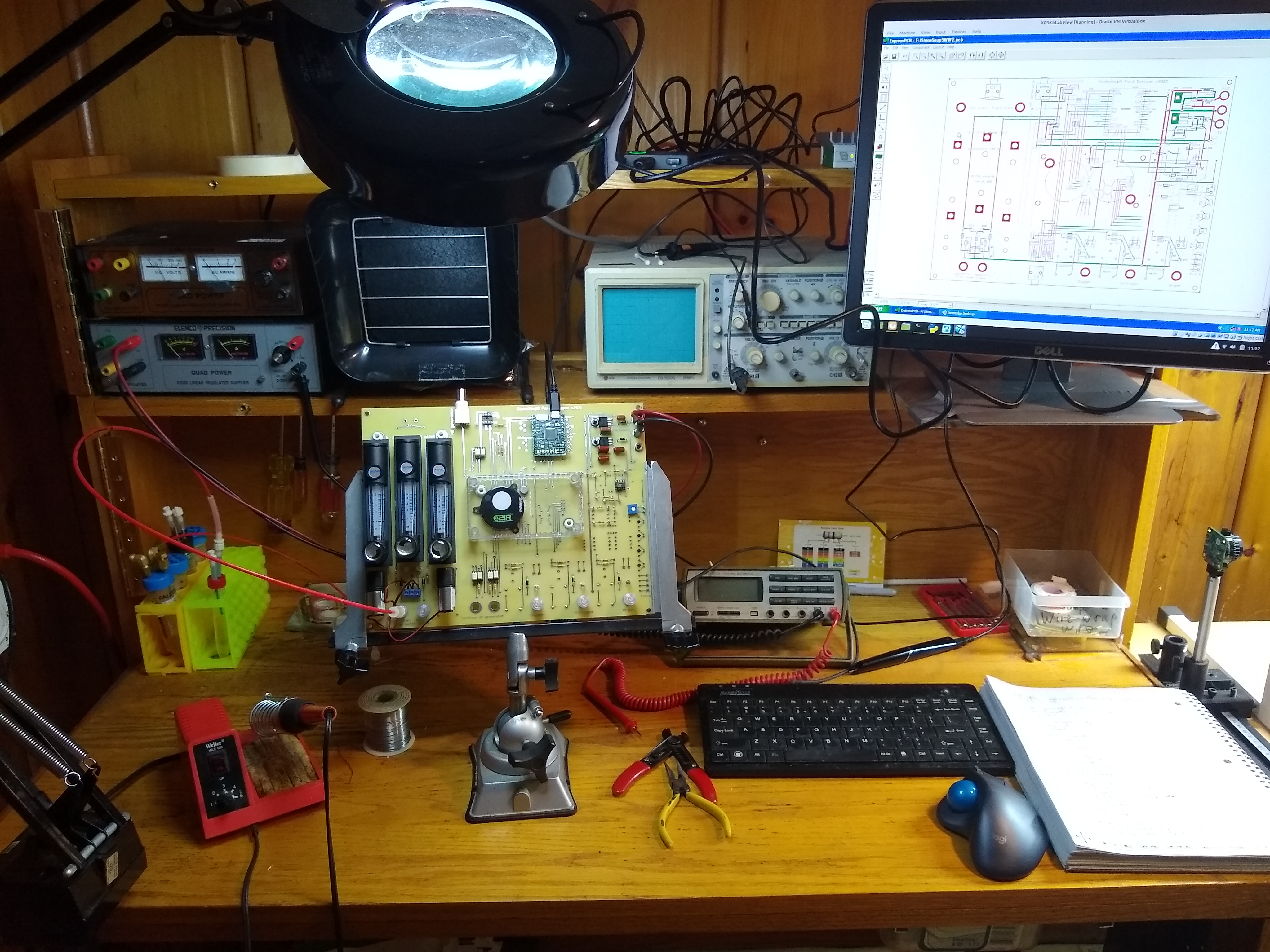
Then Covid hit, locking me out of my lab at the University of Minnesota. So, what could I do in my basement workshop at home, that would be useful to future research on nitrogen fixation? I’d played with electronics and microcomputer-based instrumentation ever since Mike Colyar got me started back at Evergreen, but I hadn’t been keeping up with the latest advances. How much could a microcomputer-based instrument cut costs? Quite a lot, it turned out. I tried an Arduino, then a pyboard (below), but eventually chose the powerful, widely-available, $6 Raspberry Pico as the heart of an inexpensive, multifunctional, Python-powered instrument, mostly for nitrogen-fixation research. I’m calling it the Pretty Good Philosophical Instrument, Pretty Good PI, or just PI. I hope you like it. I’ll continue this story in the blog.
R. Ford Denison
rfdenison@prettygoodpi.com